 "Indonesia Forward"
The philosophy behind our name, our mark, and the words we stand behind — each one rooted in Indonesian heritage, each one pointing forward.
"Indonesia Forward"
The name Majapahit is not chosen lightly. It refers to one of the greatest empires in the history of Southeast Asia — a civilization that, at the height of its power in the fourteenth century, commanded the trade routes of the Indonesian archipelago and projected its cultural, legal, and commercial influence across the Indian Ocean world.
Founded in 1293 in East Java, the Majapahit Empire reached its zenith under King Hayam Wuruk and his visionary prime minister Gajah Mada. Gajah Mada's Palapa Oath — his vow not to taste the pleasures of life until he had unified the entire archipelago under Majapahit's banner — remains one of the most celebrated acts of national ambition in Indonesian history. The empire he helped build was not one of conquest alone; it was a civilization of letters, law, trade, and diplomatic sophistication. Its court spoke multiple languages, maintained embassies across the region, and regulated commerce with a precision that many modern institutions would admire.
For Majapahit Group, the name carries a deliberate message to every client: that Indonesia's commercial history is one of global ambition, institutional sophistication, and border-crossing enterprise — and that this firm intends to carry that tradition forward.
"Lamun huwus kalah Nusantara, isun amukti palapa." — Gajah Mada
"When Nusantara is conquered, then I shall taste the palapa." The Palapa Oath, circa 1336 — one of the founding statements of Indonesian national ambition.
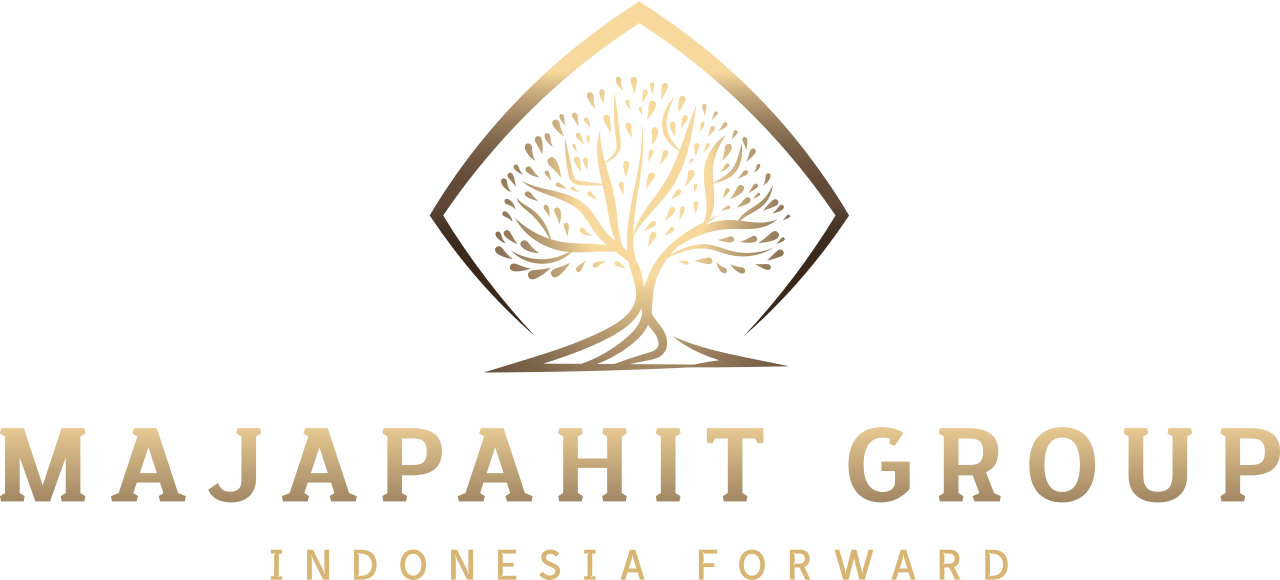
Every element of the Majapahit Group logo is intentional. The mark was designed not as a decorative emblem but as a visual statement of values — rooted in Indonesian symbolic tradition while speaking the visual language of international professional practice.
It is a logo that rewards attention. The more one understands its elements, the more clearly it articulates what this firm stands for: deep roots, principled structure, upward growth, and the warmth of a tradition that has always understood the world as a place of interconnected commerce and shared human enterprise.
The central image of the logo is the Pohon Beringin — the sacred Banyan tree. In Indonesian culture, the Beringin is among the most revered symbols in the national lexicon. It appears in the Garuda Pancasila, Indonesia's state emblem, where it represents the unity of the Indonesian people sheltered under one canopy.
In Javanese tradition, the Beringin was planted at the center of the alun-alun, the town square — it was literally the axis of community life, justice, and governance. Rulers held court beneath its branches. Communities gathered around its roots. It was both shelter and witness.
The tree's branching canopy reaching upward and outward symbolizes the firm's advisory reach — across jurisdictions, industries, and practice areas — while its deep, intertwining roots represent the foundational knowledge and Indonesian expertise that grounds every engagement. A firm without roots cannot hold in difficult terrain. A firm without reach cannot serve clients navigating the world.
Encasing the tree is a geometric diamond — a rhombus shape that carries multiple layers of meaning rooted in Indonesian culture and the universal language of professional precision.
The diamond's angular form speaks to structure: the discipline of law, the precision of financial analysis, and the exactitude required in cross-border advisory. Where the tree is organic and expansive, the frame is controlled and defined. Together, they create the firm's essential tension: the organic ambition of growth, held within a framework of professional discipline.
In traditional Javanese and Indonesian batik — the UNESCO-recognized textile art form — diamond and rhombus patterns (the ceplok motif) are associated with the cosmos, order, and the balance between opposing forces. The frame also echoes the shape of the Keris blade, Indonesia's most iconic ceremonial object, a UNESCO World Heritage item representing honor, heritage, and cultural identity. To those who recognize it, it is a quiet signal of deep belonging.
The apex of the diamond points upward — a vector of aspiration, ambition, and advancement that mirrors the firm's commitment to client outcomes.
The mark flows from a deep, warm bronze at the roots to luminous gold at the crown — and this gradient is not merely aesthetic. It is a narrative rendered in color.
Gold — emas in Indonesian — has carried the highest symbolic weight in Indonesian court culture for centuries. In Javanese and Sundanese royal tradition, gold was reserved for the nobility and the sacred. Golden kris handles, golden headdresses, golden palace finials — gold marked legitimate authority, trustworthiness, and the highest human achievement. For Indonesian clients, the gold in this mark speaks directly to those associations. It says: this is a firm that operates at the level where excellence is expected.
The gradient's movement from earth-toned bronze to shining gold mirrors the firm's core value proposition: meeting clients where they are, grounded in the practical realities of their situation, and guiding them toward their highest potential outcome. The roots are bronze — they are in the earth, in the detail, in the work. The canopy is gold — it is what becomes possible when the work is done right.
For international clients, gold universally signals quality, prestige, and the kind of careful craftsmanship that justifies trust. The palette speaks across cultures.
Three words. A great deal of intention behind them.
"Indonesia Forward" is a statement of directional purpose, not merely a geographic label. It encodes the firm's entire thesis about where value lies and where it is going. Every word carries weight, and together they form a commitment — to clients, to the countries in which the firm operates, and to the idea that Indonesian commercial sophistication deserves to be met with an equally sophisticated professional partner.
Not merely a geography — a commitment. The word "Indonesia" in our slogan affirms that this firm's identity is inseparable from deep Indonesian market knowledge, cultural fluency, and bilingual expertise. We do not simply work in Indonesia. We know it.
"Forward" is a word of motion, optimism, and intent. It signals that the firm exists to advance — to move capital, move cases, and move careers in a positive direction. It also carries a historical note: Indonesia's trajectory as a major global economy is forward, and this firm is positioned precisely at that leading edge.
The slogan is addressed jointly to Indonesian and American clients alike. For Indonesian clients, it affirms confidence in their country's global future. For US clients and partners, it is an invitation — to engage with Indonesia's momentum, through a firm that understands both sides of the relationship completely.
The slogan also carries a professional message. In Indonesian business culture, the concept of maju — moving forward, advancing, progressing — is one of the most valued aspirations. To be described as maju is a high compliment; it means a person, company, or community is developing, not standing still. "Indonesia Forward" draws on this cultural resonance: it says the firm embodies maju — the spirit of purposeful advancement. It is, ultimately, the most Indonesian thing we could say about ourselves.