 LEXINDOR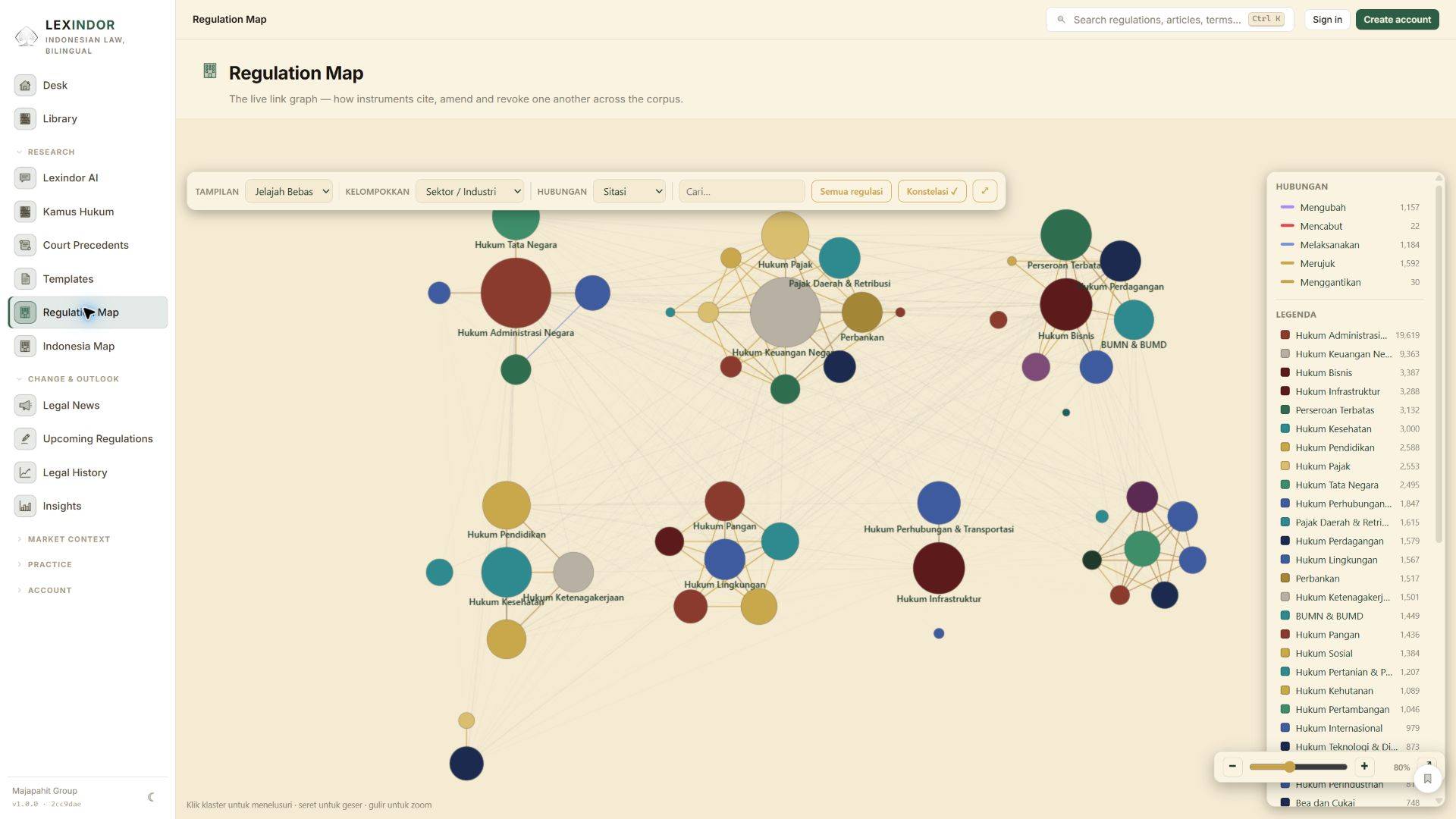
Research with citations
Follow references to the underlying articles and assess the provisions in context.
Indonesian law. Connected intelligence.
Research the rules, the institutions behind them and the parties you work with—in one bilingual workspace.
Free throughout the trial period. Open by invitation to practising lawyers at Indonesian law firms.
Request an InvitationApplies to both showcases. Your device’s reduced-motion preference takes priority.
Explore citations, amendments, revocations and implementing rules as a connected network. Reorganise the clusters by sector, institution, region or era to follow the relationships relevant to your work.
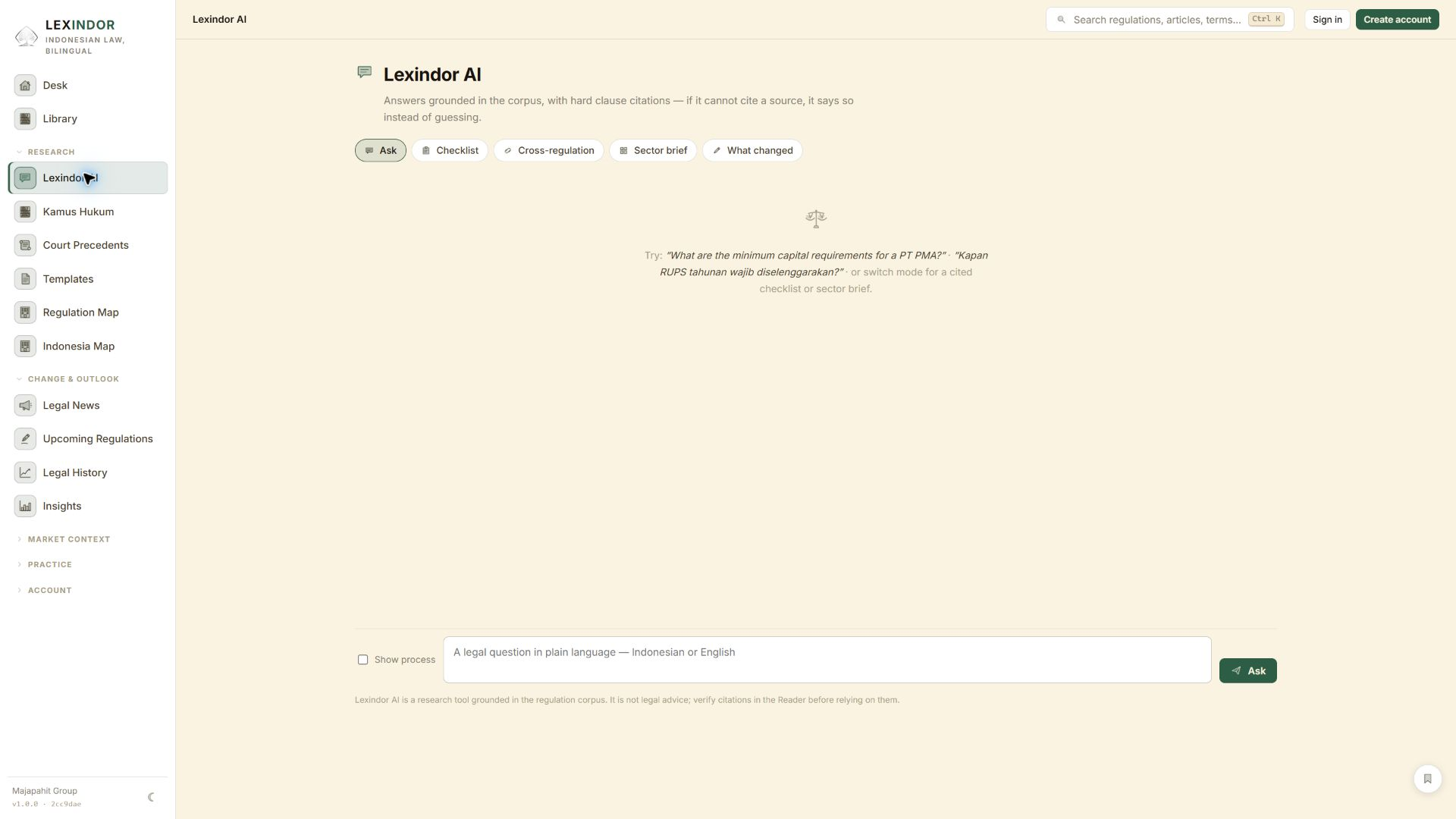
From a question to a clearer research direction. Work in Indonesian or English, prepare checklists and sector briefs, and explore cross-regulation questions with clause-level citations.
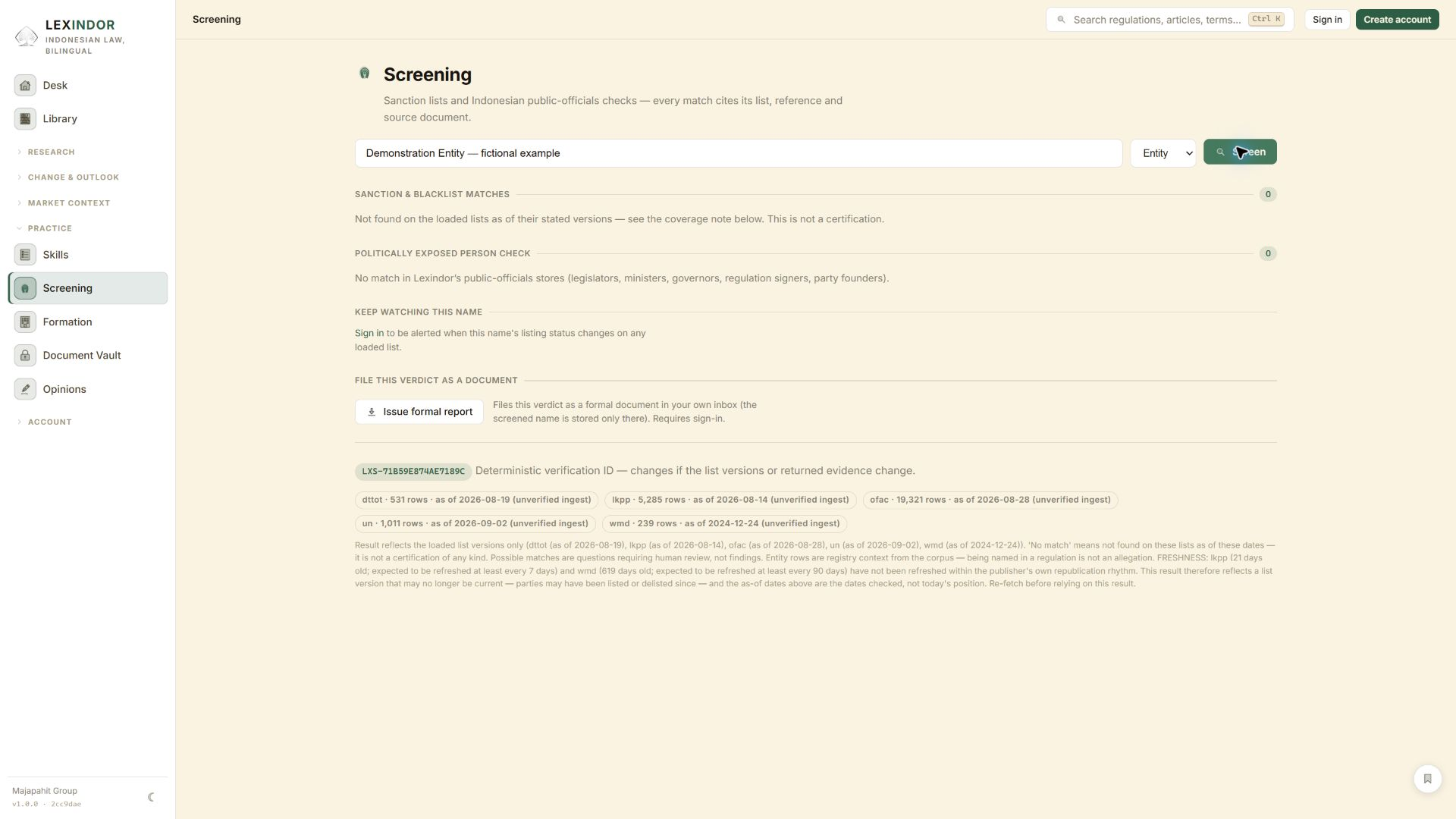
Bring international sanctions lists, Indonesian watchlists and public-official records into one screening workflow. Review exact and possible matches with source dates and supporting evidence close at hand.
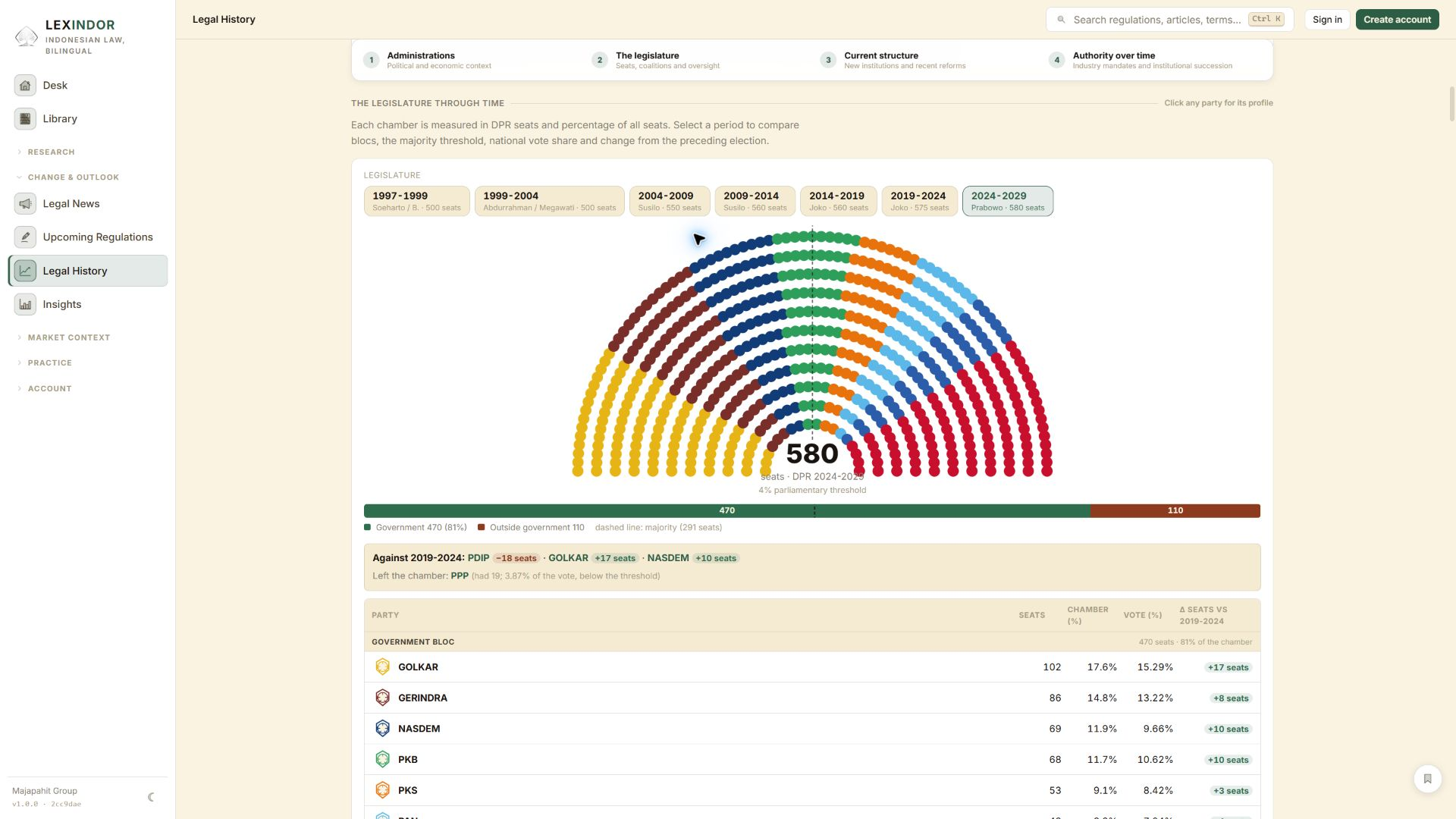
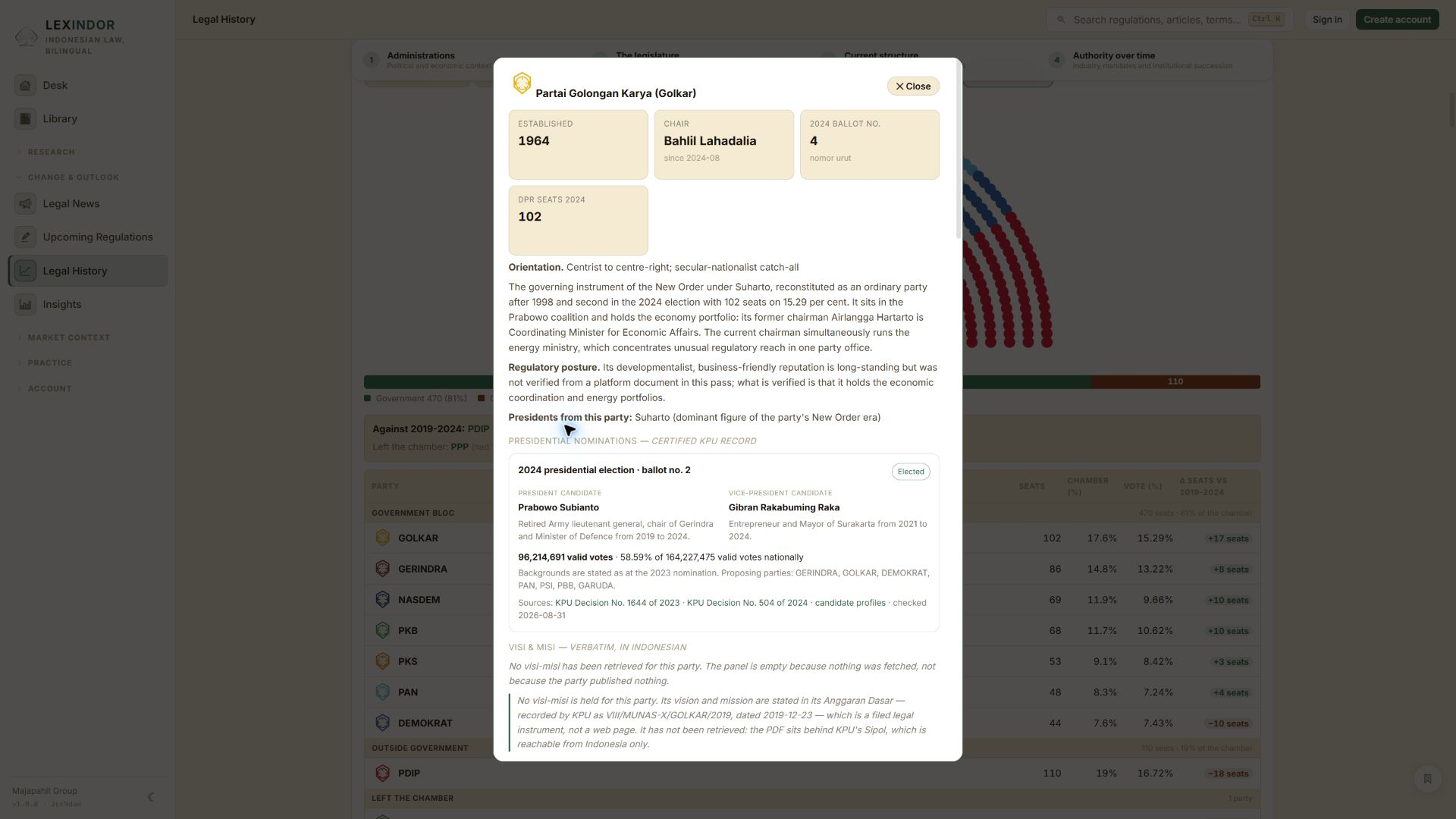
Understand the balance of parliamentary representation across seven periods. Compare party seats, vote shares and electoral gains or losses through a clear, seat-by-seat view of the DPR.
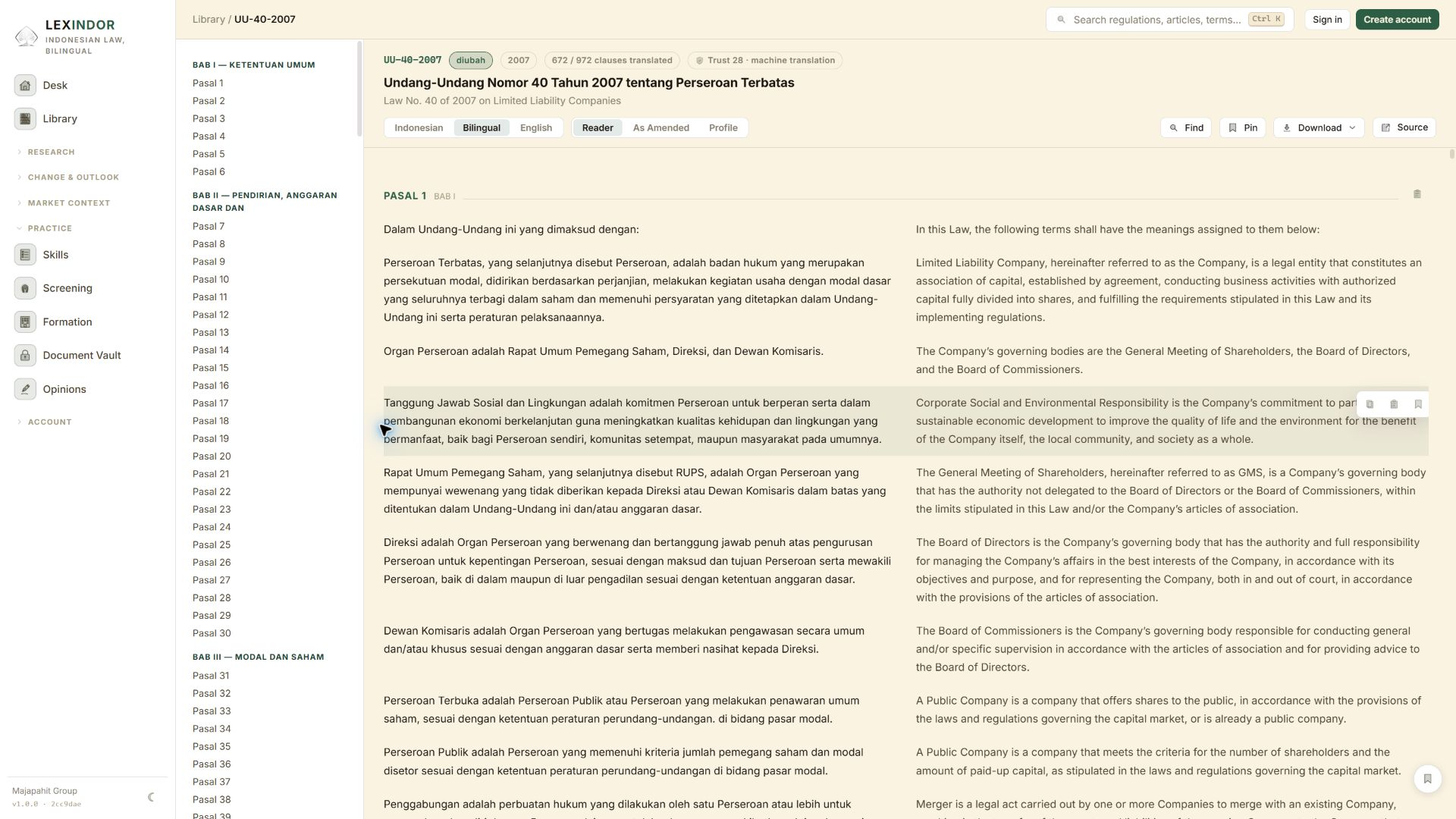
Read Indonesian provisions and the available English translation side by side. Keep article numbering, source references and instrument status close to the text you are researching.
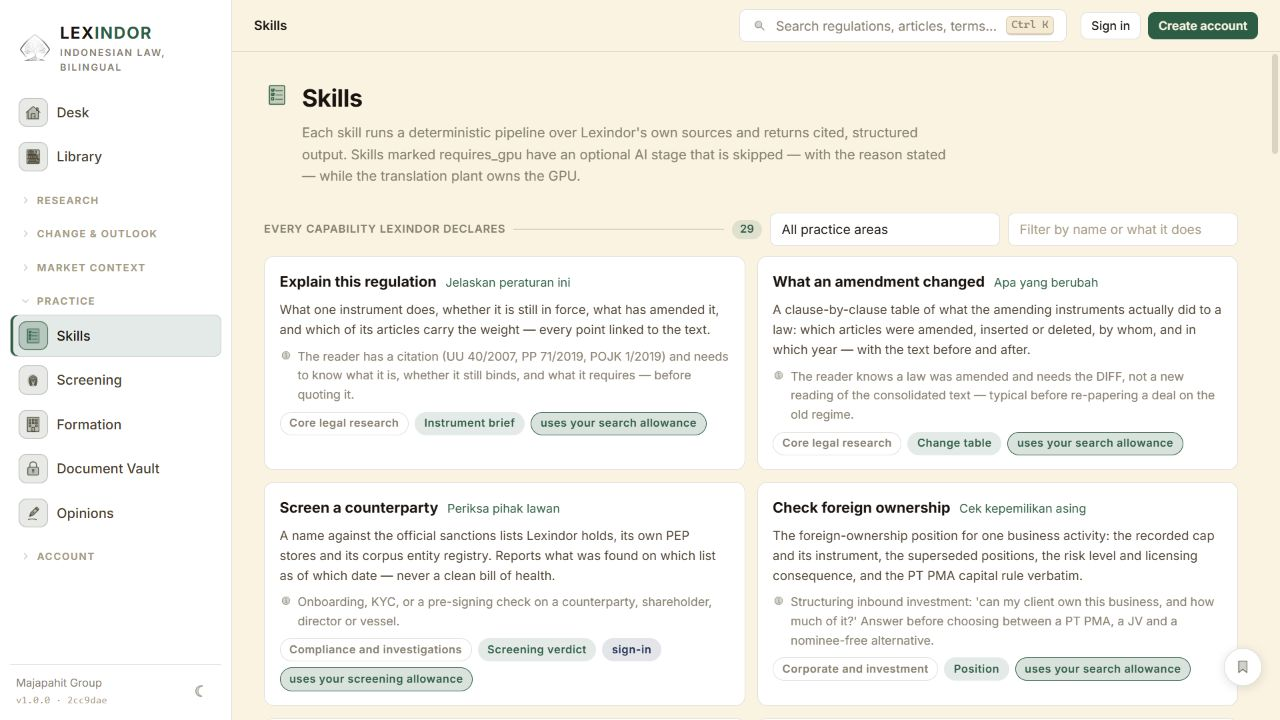
Choose from 29 workflows for amendment comparison, obligations, penalties, ownership and transaction planning. Defined inputs lead to structured results with supporting evidence and visible coverage gaps.
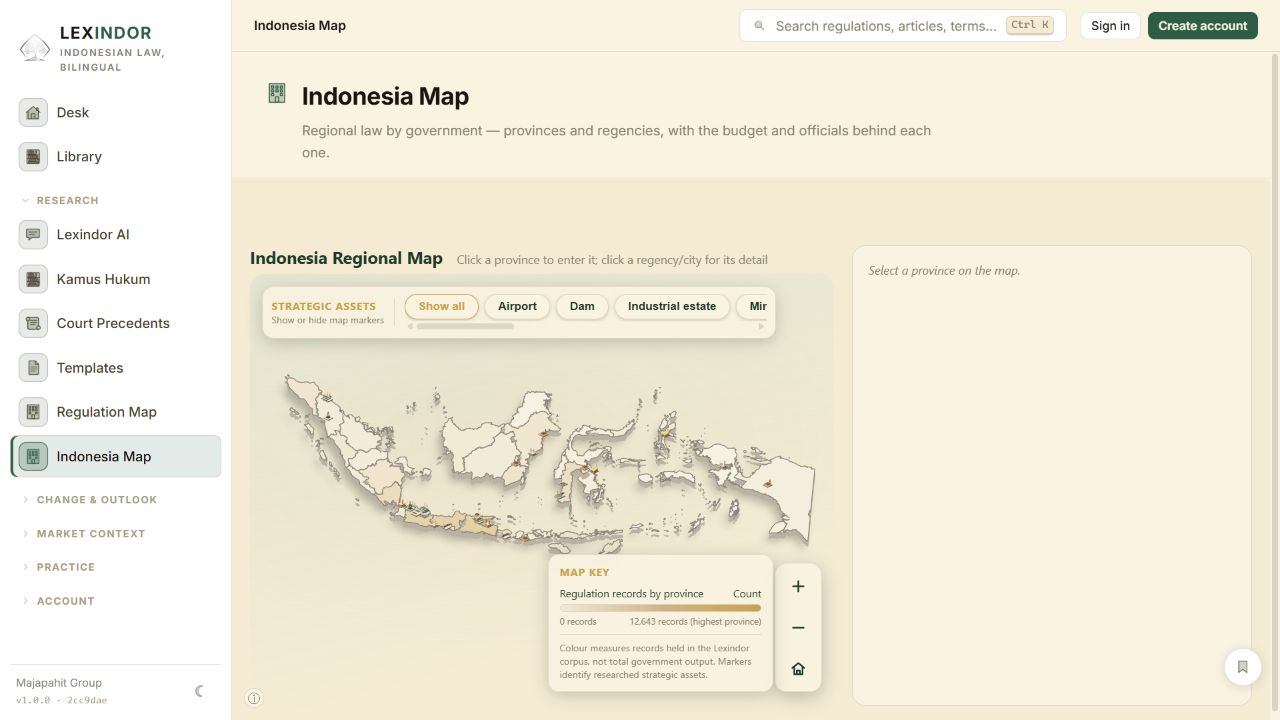
Explore provinces and regencies on the Indonesia map, then connect local regulations with available government, office-holder, budget and strategic-asset records.
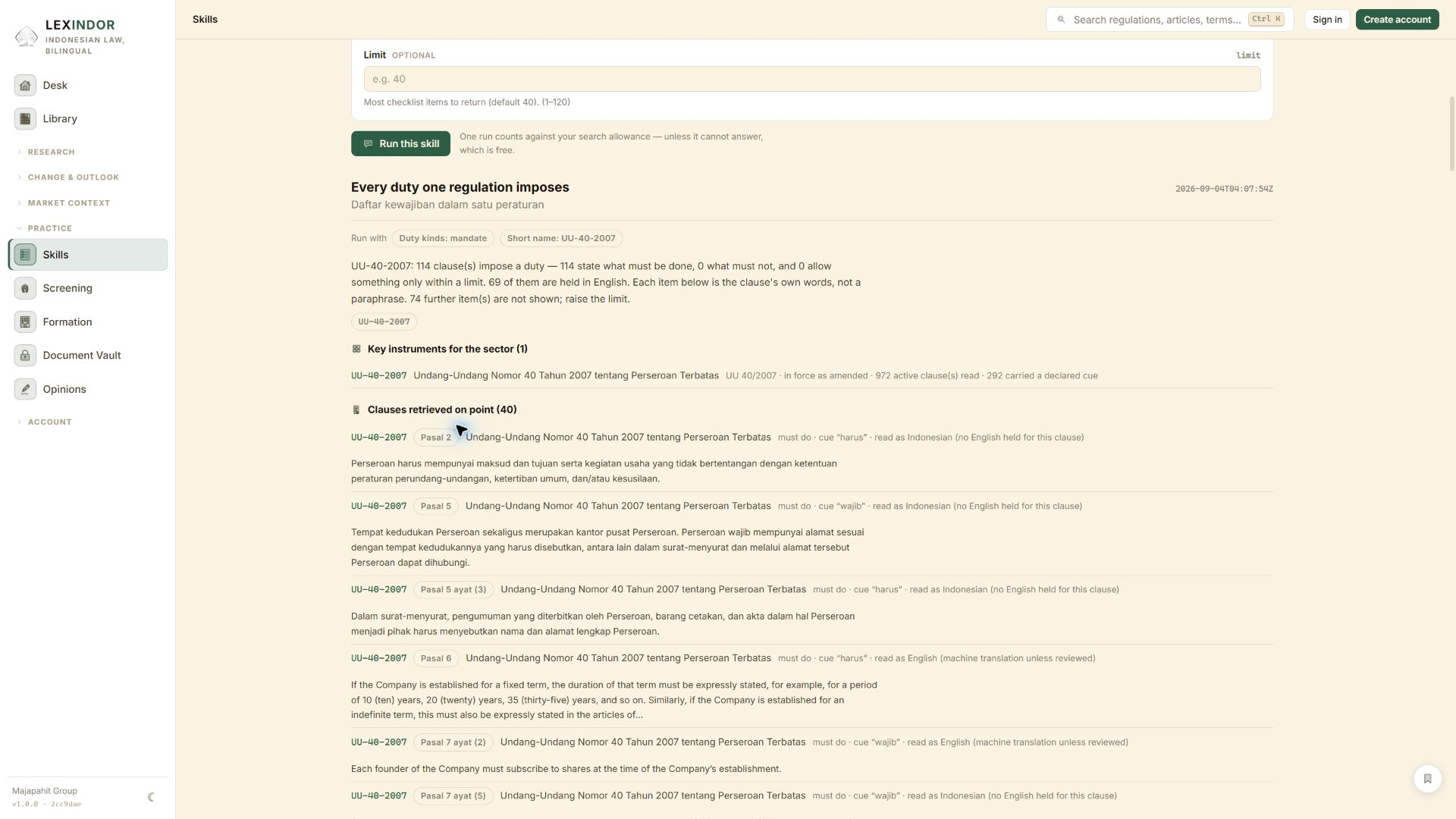
Move from a lengthy regulation to a focused review of duties, prohibitions and restrictions. Keep each item linked to its original provision as you develop your compliance checklist.
Look beyond the seat count. Explore party leadership, electoral history, KPU registration and available candidate records to build a more informed understanding of Indonesia’s political landscape.
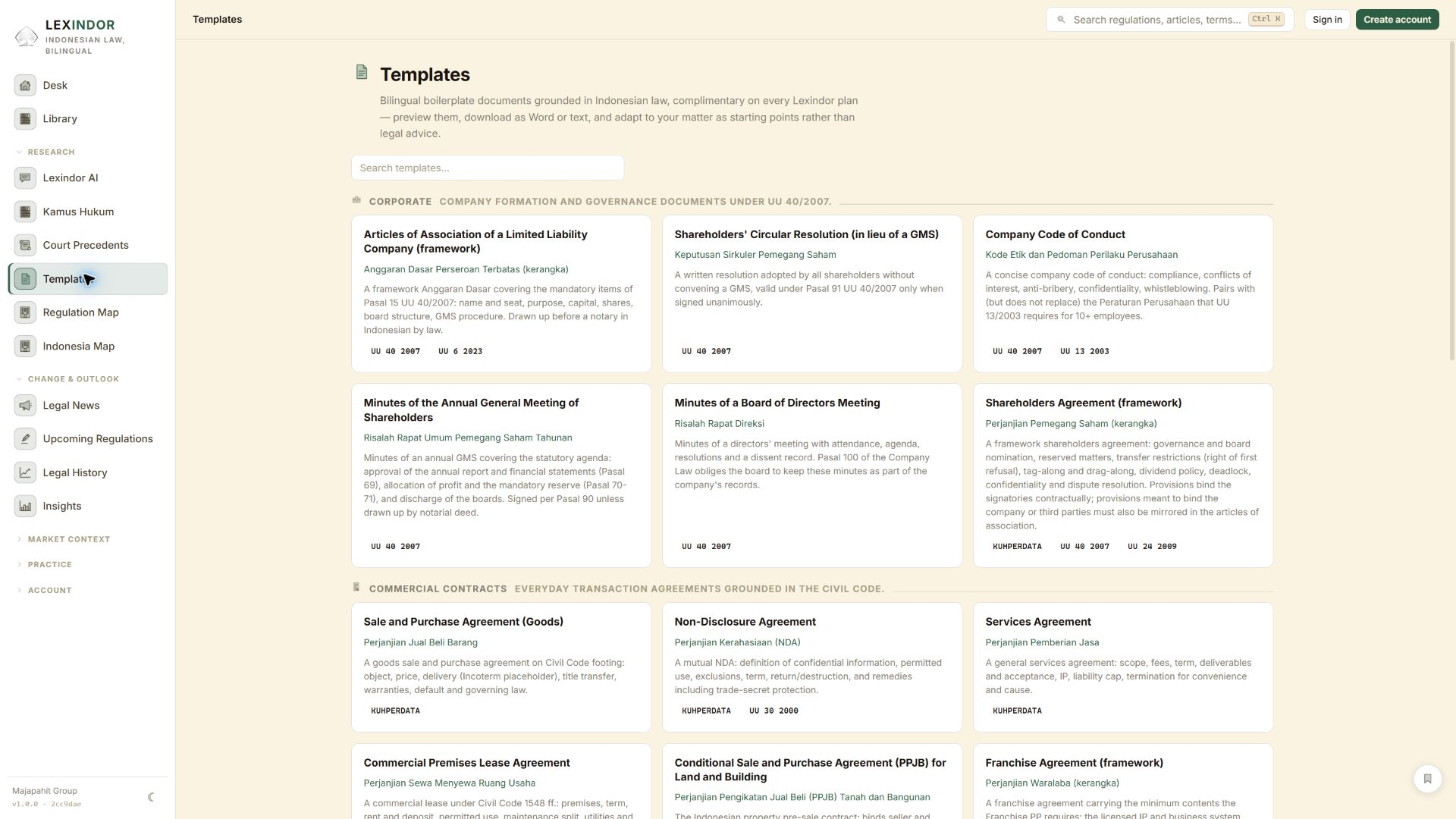
Start from 22 bilingual templates organised for Indonesian practice. Use the categories and drafting guidance to select a starting document, then adapt it to the matter and review it professionally.
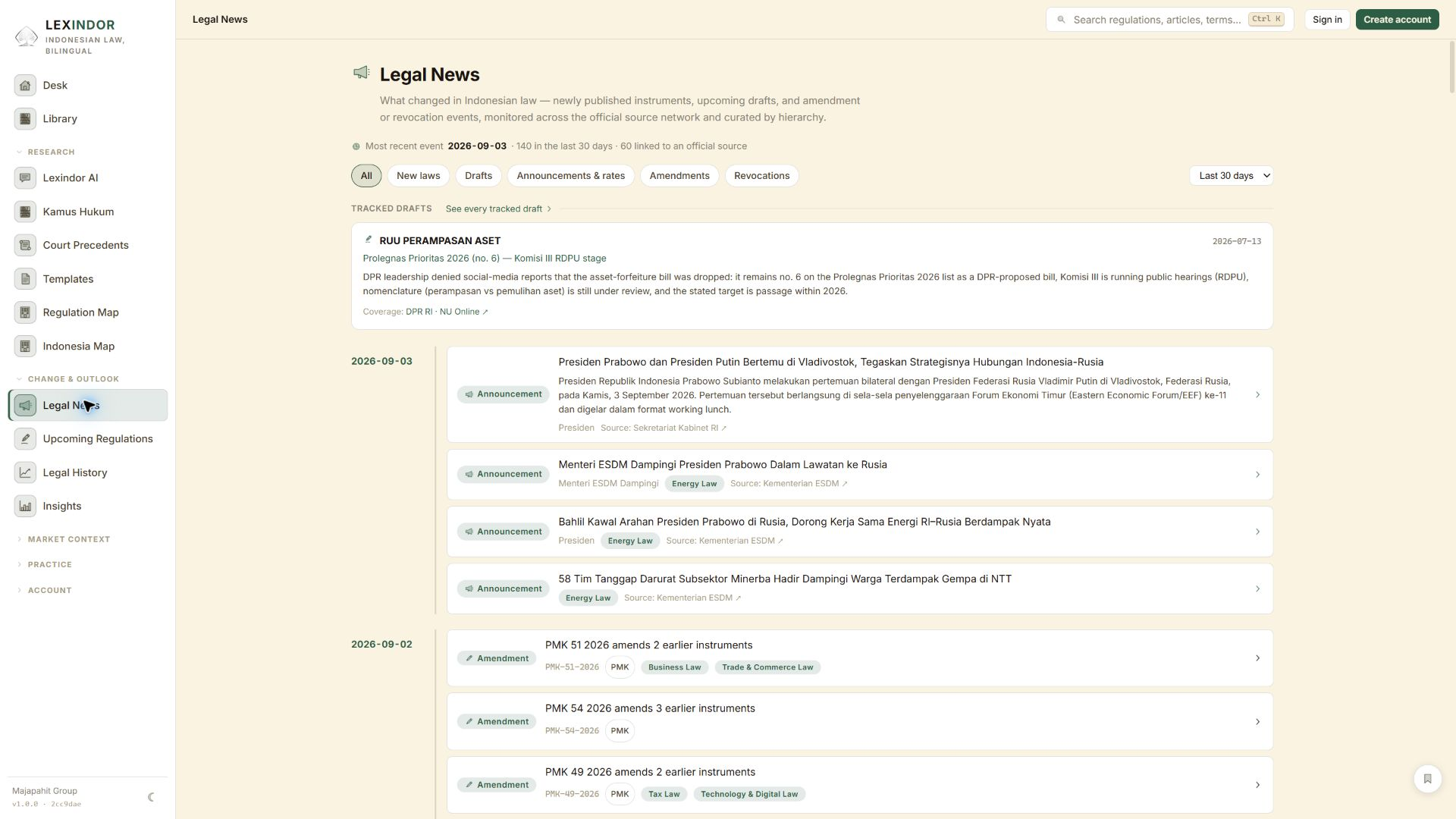
Follow new instruments, amendments, revocations and official announcements in one feed. Open the primary source to investigate a change and the instruments it affects.
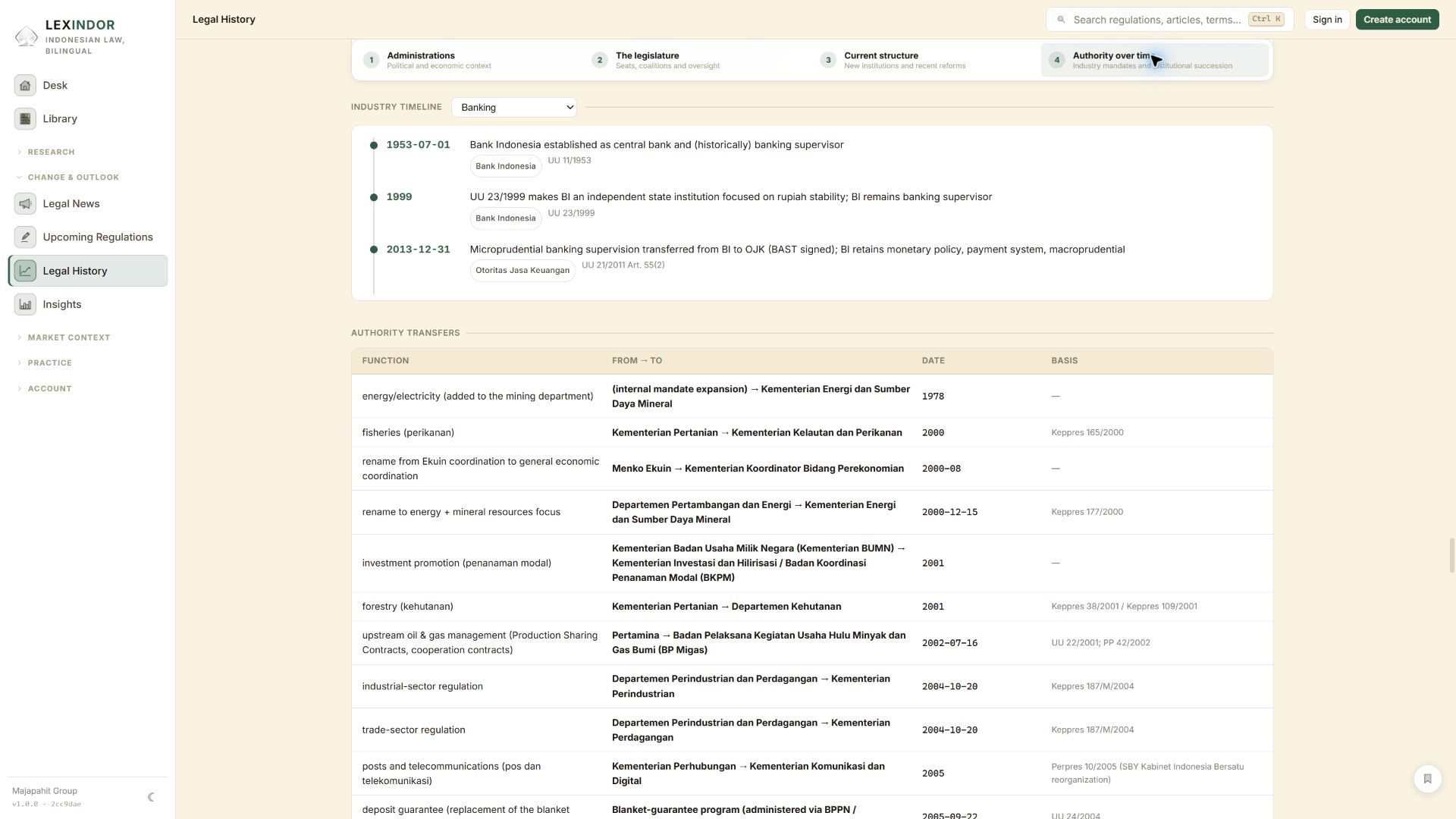
Trace responsibility across institutions and time. Industry timelines connect the creation of an authority, changes in its mandate and transfers of responsibility to the recorded legal instruments.
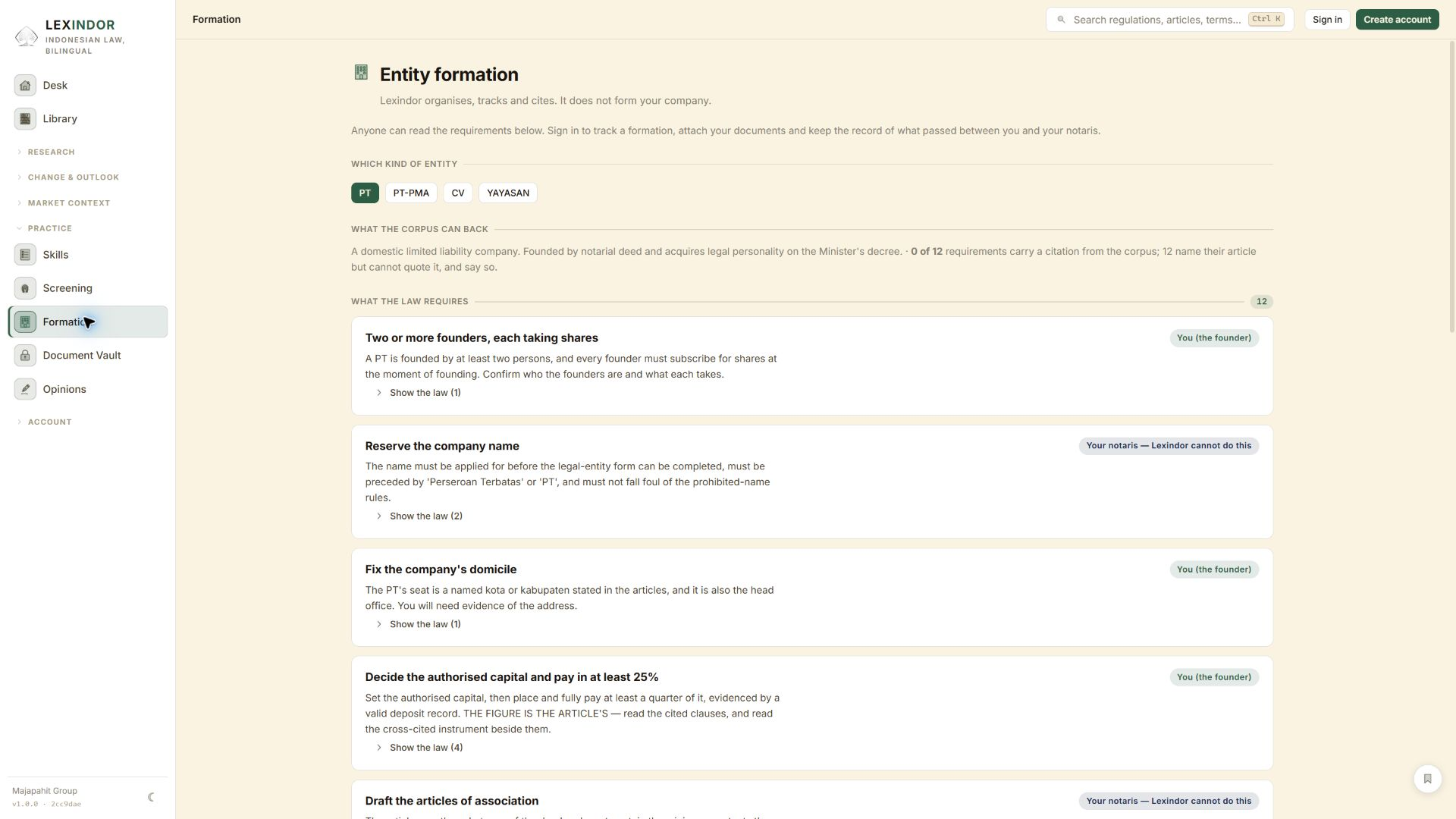
Explore entity choices and organise the requirements for establishing a business in Indonesia. Source-linked checklists help structure the research before professional advice, filing and approvals.
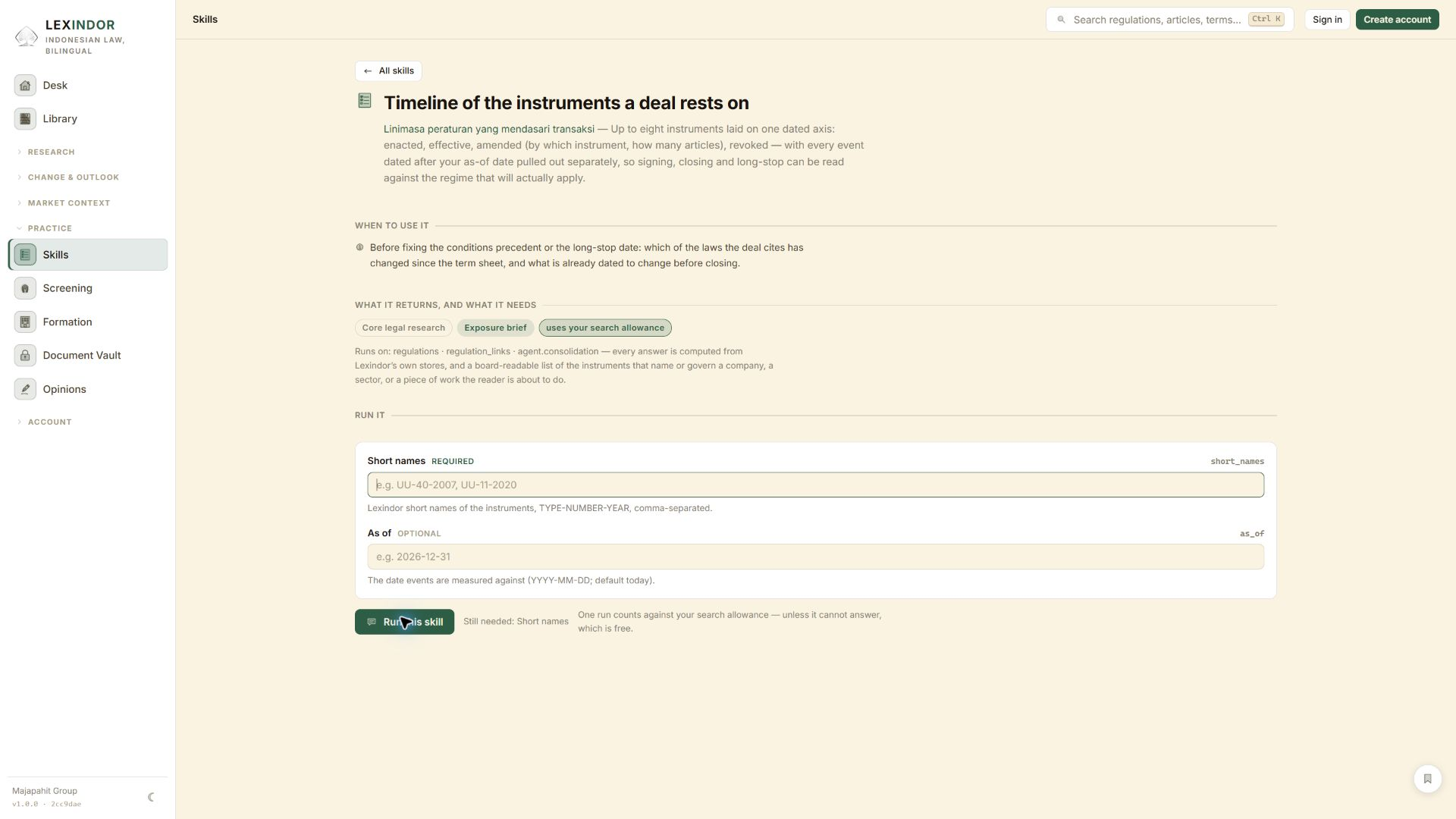
Bring the regulatory history of a transaction into focus. Organise relevant instruments and recorded changes around the date that matters to your work.
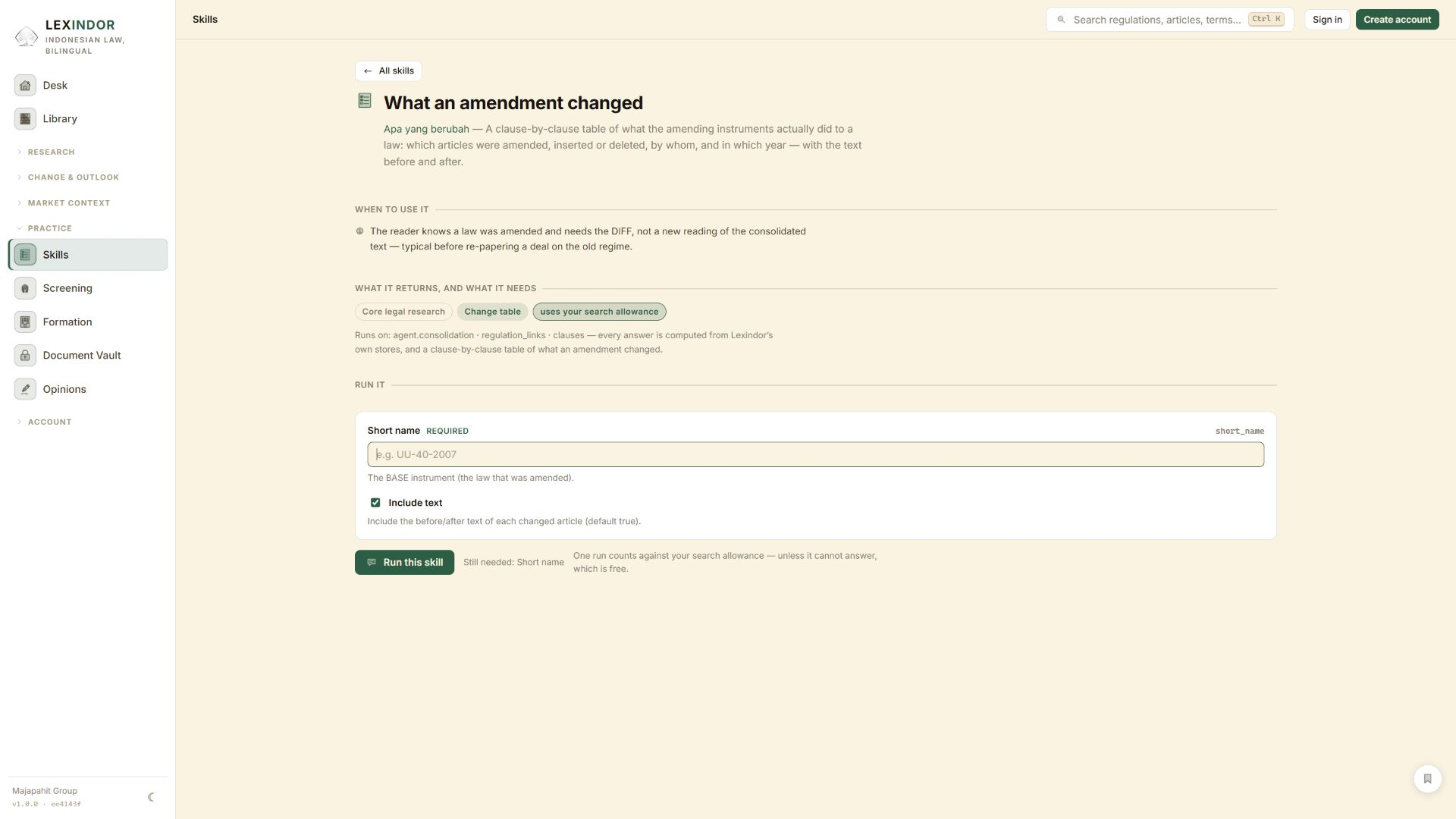
Follow a change beyond the title of an amending regulation. Compare affected provisions and return to the source wording to understand what has changed.
Fifteen connected capabilities. One clearer view of Indonesian law, institutions and business.
Turn a complex Indonesian law question into a focused research brief. Lexindor AI connects your inquiry with relevant provisions, so you can examine the legal basis and develop your analysis with greater clarity.
Explore the AI interfaceFollow references to the underlying articles and assess the provisions in context.
Work in Indonesian or English, with available translations alongside the original text.
Combine meaning-based search, where available, with connected regulations and structured research workflows.
Designed to support professional judgment. Check the cited sources and the coverage available for your question.
Connect the detail of a provision with the people, institutions and places that shape its application.

Cluster regulations by sector, authority, place or period. Follow the specific relationship—amendment, revocation, implementation or citation—to the underlying instrument.
Combine clause-cited research with neural, meaning-based retrieval where available. Ask questions, prepare briefs and investigate connections across regulations.
Review counterparties against available UN, OFAC, DTTOT, proliferation-financing and LKPP records, alongside Indonesian public-official information.
Compare seats and vote shares across seven parliamentary periods. See the majority threshold, party gains and losses, parties leaving the chamber and recorded coalition groupings.
Keep Indonesian provisions and available English translations side by side, with article references always within reach.
Choose a focused path through 29 research workflows, from obligations and penalties to ownership and transaction planning.
Move from a province or regency to its available regulations, public officials, budgets and strategic assets. Keep national and local context together as you investigate a location.
Build provision-linked obligation checklists and inspect sanction-bearing clauses in their own words. Keep the operative wording beside the task, deadline or exposure you are researching.
Connect party profiles to KPU registration, leadership, election results and candidate or member records. Inspect available party statements in their original words, with the source attached.
Build on 22 bilingual starting documents for Indonesian practice, then tailor the drafting to your matter.
Keep regulatory developments in context, with new instruments and official announcements connected to primary sources.
Follow how mandates moved between ministries, regulators and other institutions. Industry timelines connect authority transfers and organisational changes to their recorded legal basis.
Frame business-establishment research around entity choices, formation requirements and recorded foreign-ownership rules.
Organise a transaction’s regulatory milestones around a reference date, bringing recorded changes into a clearer sequence.
See which articles were amended, inserted or removed, with the before-and-after wording available for closer review.
A substantial foundation for Indonesian legal research—bringing regulations, article-level analysis and connected intelligence into one workspace.

Figures as at 4 September 2026. Coverage varies by collection; indexing does not mean full-text or English availability. Screening totals include historical entries from five lists still under verification.
Open the article behind a research result. Citations, declared inputs and missing coverage make the reasoning easier to check.
Search by instrument title, exact citation or parsed article text. Meaning-based retrieval adds another route where the semantic index is available.
Assess a finding with its source, date and verification status in view. Screening lists, political records and regional collections remain subject to source verification.
Available English is aligned with the Indonesian text. Translation memory supports consistency; translations and consolidated texts remain unofficial research aids.
Possible screening matches and potential regulatory conflicts are flagged for review. A non-match is not a clearance, and a conflict candidate is not a court finding.
Move between the customer web and desktop interfaces with a familiar set of research tools. Access is being prepared for a limited invited programme.
Preparing the research experience and reviewing source coverage for the first invited firms.
Planned access for a limited cohort of Indonesian law firms, with direct support and a defined trial scope.
Target wider availability and published pricing, subject to readiness and validation.
Closer connections between court decisions and the provisions they consider, helping researchers place statutory wording in judicial context.
More aligned English coverage of Indonesian commercial law, supported by careful translation review.
Private-document research, contract review and multi-document due diligence are being prepared for the invited programme.
Next, we are preparing industry dossiers and country profiles, alongside broader case-law and English-language coverage. Availability will follow source verification and product readiness; planned dates may change.
Invitations are extended to practising lawyers at Indonesian law firms only, and participation is free of charge throughout the trial period. Feedback is appreciated.
Lexindor produces unofficial translations and derived consolidated texts for research purposes. They are not official legal texts and do not replace the promulgated Indonesian originals. Capabilities described on this page, including those marked as in development and any targets stated, are subject to change, delay, or withdrawal, and are not commitments. Requesting an invitation creates no contractual relationship and no attorney-client relationship, and does not guarantee access to the platform or that the platform will be released. Nothing on this page constitutes legal advice or an offer of services.